


The statue of Lupa Capitolina

Statuia Lupa Capitolina din Cluj-Napoca, amplasată pe Bulevardul Eroilor, simbolizează legătura istorică dintre România și Roma antică.

The statue of Lupa Capitolina is one of the symbols of the Italian Republic capital, the city of Rome, which represents the mythological founders of this city. After the recognition of the Romanian unitary national state by the Treaty of Versailles, in 1921, the Italian state donated two copies of this statue: one for the city of Chisinau and another for the city of Cluj.

During the horthyste administration of Cluj, which followed the Vienna’s dictate, the statue was moved to Sibiu, returning to Cluj after the Second World War. In 1967, at the proposal of Professor Constantin Daicoviciu, it was placed in front of the “Babeş-Bolyai” University headquarters, in 1973 it returned to Union Square and, after being restored by the National History Museum of Transylvania, it was located on Eroilor Boulevard. The sculpture is made of bronze, and on the pedestal appears the Latin inscription: “Alla Citta de Clvj, Roma madre, MCMXXI”.

The statue of Baba Novac

Statuia lui Baba Novac din Cluj-Napoca, situată lângă Bastionul Croitorilor, onorează memoria bravului comandant al lui Mihai Viteazul.

Baba Novac, one of the main commanders of Mihai Viteazul, was executed in the central square of Cluj. His impaled body was publicly displayed near the city wall, in the place where today is the Tailors’ Bastion and which, at that time, was one of the entrance gates to the city. After the victory at Gurăslău (August 3, 1601) Mihai Viteazul hoisted a flag on that place in honor of his commander. In the interwar period, in 1936 a crucifix was built on that place, and since 1975, we find a statue of Baba Novac, the work of the sculptor Virgil Fulicea.

Transylvanian School Statuary Group

Grupul statuar Școala Ardeleană din Cluj-Napoca, omagiu adus corifeilor care au promovat cultura și identitatea națională românească.

The main Romanian Enlightenment movement was promoted in Transylvania by the Romanian United Church with Rome and was called the Transylvanian School. This movement supported the Latin origin of the Romanian people and the Latinity of the Romanian language. The most important personalities of this movement were Samuil Micu, Gheorghe Şincai and Petru Maior.

A monument dedicated to the three personalities was placed in 1973 in front of the headquarters of the “Babeş-Bolyai” University, on Mihail Kogălniceanu Street. The monument was made in bronze by the sculptor Romulus Ladea, the three personalities represented in dimensions close to the natural ones being placed on a base paved with travertine.

The statue of Saint George

Statuia Sfântului Gheorghe din Cluj-Napoca, amplasată lângă Biserica Reformată, simbolizează lupta dintre bine și rău

In 1373, the Cluj craftsmen made, at the request of Emperor Charles IV, a representation of St. George killing the dragon. This statue is located in the Old Town of Prague. At the beginning of the 20th century, the municipality of Cluj decided to make a copy of this statue.

Currently, this equestrian monument is located on M. Kogălniceanu Street, in front of the Reformed-Calvinist Cathedral, and on its pedestal is the Latin inscription: A.D. MCCCLXXIII HOC OPUS IMAGIS S. GEORGII PER MARTINUM ET GEORGIUM DE CLUSSENBERCH CONFLATUM EST (in an approximate translation, “The Year of the Lord 1373. This work represents Saint George and is made by Martin and George of Cluj”).

The statue of Michael the Brave

Statuia ecvestră a lui Mihai Viteazul din Cluj-Napoca, simbol al unirii și curajului, domină piața ce îi poartă numele.

Michael the Brave (1593-1601) was the Romanian voivode who achieved for the first time the political union of the principalities of Wallachia, Moldavia and Transylvania. The last moments of the ruler’s life are related to Cluj, he was assassinated at Câmpia Turzii.

The statuary group of the ruler represented in equestrian aspect was made by the sculptor Marius Butănoiu and is located in the central square of Cluj-Napoca named after the voivode. The monument is decorated with bas-reliefs that represent important moments related to the achievement of the Romanian principalities political union and with a heraldic representation of the new state, the three coats of arms reunited in a single coat of arms. On the pedestal is written the text “Michael the Brave -1593-1601, Lord of Wallachia, Transylvania and the whole Country of Moldova”.

The statue of Avram Iancu

Statuia lui Avram Iancu din Cluj-Napoca, situată în fața Catedralei Ortodoxe, simbolizează lupta și spiritul național românesc.

In 1995, in the area between the Lucian Blaga National Theater and the Orthodox Cathedral, the municipality placed the work of the sculptor Ilie Berindei representing Avram Iancu. Avram Iancu (1824-1872) was the leader of the Romanian revolution of 1848 in Transylvania, managing to resist the attacks of Lajos Kossuth, the leader of the Hungarian revolutionary troops.

The statue was made of bronze, on a pedestal of stone blocks, in the middle of an artesian well. The pedestal is surrounded by a statuary ensemble that symbolizes three tulnicărese – women from the Apuseni Mountains who used a popular tool to send messages between villages in the mountains.

The Matthias Corvinus Monumental Ensemble

Monumentul Mathias Rex

The Matthias Corvinus Monumental Ensemble is located in Unirii Square, the main central public place of Cluj-Napoca. King Matthias Corvinus (1443-1490) was one of the greatest kings of Hungary and was born in Cluj, being the son of the voivode Iancu de Hunedoara (1407-1456) and Elisabeth. The model of the monumental ensemble made by the sculptors Janos Fadrusz and Lajos Pakey, won in 1900 the grand prize of the Universal Exhibition in Paris.

The equestrian statue of King Matthias Corvinus is surrounded at the base by the representations of the four leaders of the Hungarian kingdom: Blasiu Magyar – commander of the Black Army, Ştefan Zapolya – the second man in the Hungarian state, Paul Chinese Coin -Timiş committee, Ştefan Bathory, voivode of Transylvania. In 1919, the historian Nicolae Iorga intervened to preserve the monument on its current location and placed a plaque on the pedestal stating the Romanian origin of the Hungarian king.

Cluj-Napoca Central Cemetery

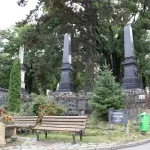
Cimitirul Central din Cluj Napoca, cu monumente funerare impunatoare, obeliscuri negre si banci pentru vizitatori, intr-o zona verde si linistita.

The Central Cemetery in Cluj Napoca is one of the oldest cemeteries, known in the past as the Hajongard Cemetery. The old name of the cemetery comes from the German dialect, Hasengarten (in translation “Garden with rabbits”), representing the name of the current cemetery location. The first attestation of Hajongard Hill dates from 1503 and is located south of Cluj medieval fortress.

At the end of the 16th century, following the plague epidemic in 1585, the cemetery becomes too small, so it is decided to settle the current cemetery location on an area of several hectares. The architectural diversity of the funerary monuments, as well as the names of some personalities with a decisive role in the political, cultural and artistic life of Transylvania, make the cemetery one of the most uncommon objectives of the city.

Starting with the 19th century, the cemetery began to be organized with designation of plots, planting trees and delimitation of the fence between denominations and nationalities. The Central Cemetery, in his current form, includes alleys, buildings with impressive architecture, funerary monuments in different architectural styles (eclectic, baroque, neoclassical, neobaroque, neogothic, neorenaissance, Art Nouveau, etc), trees and leisure venues, even cultural events. Also here, you can admire the tomb-chapel of the Bethlen family – the only neo-Roman style funerary monument in the county. Starting with 2015, the Central Cemetery in Cluj-Napoca is classified as a historical monument in the list of historical monuments.

Potaissa Roman Camp

Ruinele Castrului Roman Potaissa, cu ziduri din piatră parțial păstrate, înconjurate de iarbă, sub un cer senin.

How we arrive

The most important historical-archaeological monument of Potaissa, Turda Municipality today, is the Fortress of the 5th Macedonian Legion, built on the Fortress Hill plateau, in order to strengthen the North-West defense of the Roman Dacia. This is the largest long-term fortress from this Roman province.

The fortress had a rectangular shape, with sides of about 400-500 m, an area of ​​over 20 ha and sheltered approx. 5000 military. The defense walls had a thickness of about 2 m, being made of mortar and stone, in front of which there was a 12 m wide ditch with water. The most important building in the fortress was that of the commandment, being one of the largest buildings known in Dacia (about 1 ha).

In 274 the 5th Macedonian Legion, together with the other Roman troops, withdrew from Dacia. In the ruins of this fortress was discovered the richest category of archaeological material, ceramics, iron and bronze utensils, as well as coins, sculptures, mosaics.

Website: www.castrulpotaissa.ro

Liteni Fortress

Ruinele Cetății Liteni se înalță pe vârful dealului, înconjurate de verdeață, amintind de vremurile de glorie ale Transilvaniei

Liteni Fortress (Geczy Fortress, Lita Fortress, Gelu Fortress) is a medieval fortress built 3 km south-west of Liteni village on a cliff above the Iara Valley. It is documentary attested since 1324 under the name of “CastrumLeta”. It was a royal fortress, having an important military role in the area. This “secret capital” of Transylvania controlled together with the Colțești Fortress (Rimetea commune, Alba county), the Gilău Castle and the Bologa Fortress (Cluj county), one of the main route of the Salt Road, the salt, representing for thousands of years, the true gold of Transylvania.

The elliptical shape fortress had several owners, among which the most important were Sigismund of Luxembourg, Ladislau Kán and Ioan de Hunedoara. In 1562, during a siege, it was severely damaged due to the explosion of the underground powder storage. In 1569 the ruins and related forests in the vicinity were given to Geczy Janos who made the fortress habitable again, his descendants living here until the second half of the 17th century.

The fortress was destroyed during the Curuți liberation battles, led by prince Francisc Rákóczi II at the beginning of the 18th century.

At present the fortress is a ruin, it can be visited, access is not restricted.