


The Holy Trinity wooden Church of Agârbiciu

Biserica Sfanta Treime din Agarbiciu, o biserica traditionala din lemn cu acoperis inalt, situata intr-o zona verde si linistita, inconjurata de copaci

The Holy Trinity wooden church in Căpuș Commune, Agârbiciu village is one of the wooden architectural monuments of national interest, the painting being dated 1801. The most important object of worship in the patrimony of the church is a triptych from 1555.

Mănăstireni Reformed-Calvinist Church

Biserica Reformat-Calvina Manastireni, o cladire alba cu acoperis din sindrila si un turn inalt, situata intr-o zona linistita si verde.

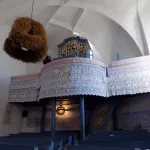
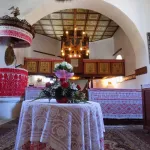
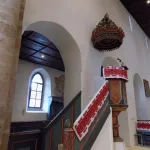
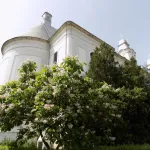
The church from Mănăstireni is considered by specialists as the most valuable of the fortified churches that can be found in Ţara Călatei. Built in the 13th century, it is a Romanesque style church hall, it is supposed to have been originally a monastery of one of the noble families in the area. The initial construction underwent several interventions, so that today we find both elements of the Romanesque style and elements of the Gothic or Renaissance style. The furniture, pulpit and coffered ceiling date from the 18th and 19th centuries.

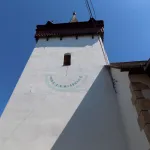
The enclosure wall dates from 1734, it represents the restoration and consolidation of some older fortifications that protected the church. The façade of the western tower contains elements that give the special value of this monument: a bas-relief with a virgin breastfeeding two snakes -a unique architectural element in Transylvania- two funerary lions from the Roman Empire, a bas-relief with St. Archangel Michael killing the dragon and a solar clock. The most imposing tower is the northern one, with a high helmet made entirely of wood and covered with shingles, with four smaller corner towers – which is a specific element of the Călata area. From the Reformation era until now, this building has remained the church of the Reformed Calvinist parish in Mănăstireni.

Văleni Reformed-Calvinist Church

Biserica Reformat-Calvina Valeni, o cladire alba cu acoperis de sindrila si turn inalt din lemn, cu detalii arhitecturale traditionale.

In Văleni village, located on the road that crosses the hills between the communes of Călăţele and Mănăstireni, the Franciscan monks built a fortified church in Romanesque style. In 1452, it was rebuilt in Gothic style, adding buttresses for the walls so that, in the 16th century, the massive tower was added, whose strategic function was to supervise the entire area. From the 17th century, the church will have two defensive walls and will become a Reformed Calvinist church to this day.

Its strategic role in history was very important, the church being the place of refuge for the population in the area during the numerous Tatar invasions. A memory of those times is the image of a Tartar carved on one of the defensive walls of the church. In the defensive wall of the church we also find a funerary relief from the Roman era.

The interior is the specific one of a church from Ţara Călatei: the coffered ceiling painted with various motifs from 1774, the embroideries specific to the area and two woven wheat chandeliers, a specific element of the reformed churches. These chandeliers symbolize the bread – the body of Christ and are about 60 years old. In the church there is a funerary monument of a nobleman from the region. A legend of the area claims that the tombstone would facilitate access to a tunnel that would reach 4.5 km away, in the village of Mănăstireni. The only certainty remains the discovery of a tunnel under the church, which, however, is collapsed in the area of the defense walls. In the vicinity of the church was arranged a small museum with various historical relics. 

Sâncraiu Reformed-Calvinist Church

Biserica Reformat-Calvina Sancraiu, o cladire alba cu acoperis de sindrila si turn inalt, inconjurata de un drum pavat si flori colorate.

Sâncraiu village is still one of the landmarks of the Hungarian community in Transylvania. The first documentary attestation of a church dates from the 13th century. The church is a fortified one, with a defensive wall and has three entrances. In its current form, the church has been preserved since the 18th century. The 220 boxes of the ceiling were restored in 1994 and painted with motifs specific to the area.

The bell tower dates from 1762 and has three bells. The most important artifact of the church is the bell in the courtyard which was given, according to tradition, by King Matei Corvin in 1481.

Sic Reformed-Calvinist Church

Biserica Reformat-Calvina Sic, o cladire alba cu arhitectura simpla si intrare gotica, inconjurata de flori si banci in curtea interioara.

Sic represented in the medieval period one of the important area of Transylvania due to the salt mine. The importance that the Hungarian royalty gave to the community from Sic is also marked by the financial support that King Matei Corvin gave for the construction of the parish church. The church was dedicated to the Holy Spirit and is an architectural monument with features specific to the Gothic style.

During the Reformation, in 1555, a Synod of the Reformed Churches from Transylvania was held in this church, a Synod attended by the founder of the Unitarian confession Francisc David. This church was several times the cathedral of the reformed Calvinist denomination in Transylvania. It was restored several times, in the 15th-18th centuries, after the Tatar invasion of 1717 which seriously damaged it in the 2000s, now being restored to its former glory. The fragments of the 14th century fresco, the coffered ceiling, the pipe organ and the bells dating from the 18th century are the elements that give it a special value.

The Ortodox wooden Church of Sic

Biserica Sfanta Treime din Agarbiciu, o biserica traditionala din lemn cu acoperis inalt, situata intr-o zona verde si linistita, inconjurata de copaci

The wooden church of Sic is one of the wooden architectural monuments of national interest, made of oak beams joined in the swallowtail technique. It dates from 1731, this year being engraved on the framing of the door of the pronaos. The windows are made of (from) handmade glass.

“Solomon” Gherla Armenian Catholic Church

Biserica Armeano-Catolica din Gherla, o cladire simpla de culoare alba, cu un turn inalt si acoperis metalic, situata pe o strada linistita

Ho we arrive

The first stone church in Gherla is the Armenian-Catholic church „Solomon”, located today on Cloșca Street. The church dedicated to the Annunciation was built between 1723-1724 with the financial support of the Solomon’s merchants family and is architecturally a mix of styles based on late Gothic.

The entrance portal, carved in stone, with decorations from the end of the 15th century, beginning of the 16th century, is flanked by two statues: St. Sylvester, Pope of Rome, and the other represents St. Gregory the Illuminator (240-332) – the one who baptized the Armenians. In 1908, two commemorative plaques were placed recollecting those who have funerary monuments in the church: brothers Solomon Simai and Bogadan Simai and their wives, the apostolic vicar Mikhail Theodorovich. 

Gherla Armenian Catholic Cathedral

Catedrala Armeano-Catolice din Gherla, cu coloane impunatoare, candelabru central, bănci de lemn și altar decorat somptuos.

Ho we arrive

The city of Gherla, known in medieval times as Armenopolis, was a city built especially for the Armenian community. A prosperous community of merchants built a city from scratch on the Someș banks and decided to build a cathedral in 1748. The cathedral was built in the center of the city and was dedicated to the Holy Trinity and St. Gregory the Illuminator – the apostle of the Armenians .

The church is a monumental construction, built in the Transylvanian Baroque style, with a main tower framed by two secondary towers. Initially, the church was surrounded by a fence on which stood the life-size statues of the Holy Apostles Peter and Paul, as well as the statues of the other apostles. These statues are inside the church today. The church has a main altar and four secondary altars: the altar dedicated to the Virgin Mary, the altar dedicated to St. Gregory the Illuminator, the altar dedicated to St. Joseph, the altar dedicated to St. John of Nepomuk. They are decorated with paintings and statues specific to the Baroque style.

The most important work of art of the church is the painting entitled “The Descent of Jesus from the Cross” which is supposed to be the work of the famous painter Rubens. This painting was given by Emperor Francis I to the Armenian community in Gherla as a token of gratitude for the generous donations made to the imperial treasury.

Dej Sinagogue

Sinagoga Dej, o cladire impunatoare cu detalii arhitecturale elaborate, ferestre mari si cupole rotunde, inconjurata de un gard de fier.

How we arrive

The city of Dej became an important center of the Jewish community at the end of the 19th century. Around 1900, the community numbered about 4,500 souls. In 1853, Rabbi Mendel Paneth from Urișor settled in Dej and took the initiative to build a synagogue. The synagogue was built between 1907 and 1909 with the financial support of the Jewish community in the area and is one of the largest in Central and Southeast Europe with a capacity of 900 people.

Web: www.turism-dej.ro/sinagoga

Dej Reformed Calvinist Church

Biserica Reformata Calvina Dej, o cladire istorica cu turn inalt si acoperis din piatra, situata in centrul orasului, inconjurata de cladiri.

How we arrive

The city of Dej was an important point on the map of medieval Transylvania due to the salt mine that has been exploited since the Roman Empire. The main church of Dej, the second parish church in this city, is documented for the first time in 1453. It was built with the support of Iancu de Hunedora and Matei Corvin. Originally a Roman Catholic church, during the Reformation it was in turn a Lutheran, Calvinist and Unitarian church.

During the reign of Prince Gabriel Bethlen, in 1612, the church became the property of the Calvinist confession and was renovated with the support of Prince George Rákóczi I. (1630–1648). It is a monumental building that preserves all the elements specific to the Gothic style: high church with buttresses and an interior vault dating from 1500. The tower on the west facade, coffered ceiling and carved pulpit are the architectural elements that give the church a special value.