The “Saint Michael” Church was built following the act issued by King Carol Robert of Anjou in the 14th century, which offered Cluj a series of privileges, including the city’s right to freely choose its priest and parish priest. The city had reached a development that required the construction of such a building, and the chosen place was the Great Square of the city instead of an old chapel dedicated to St. Jacob.
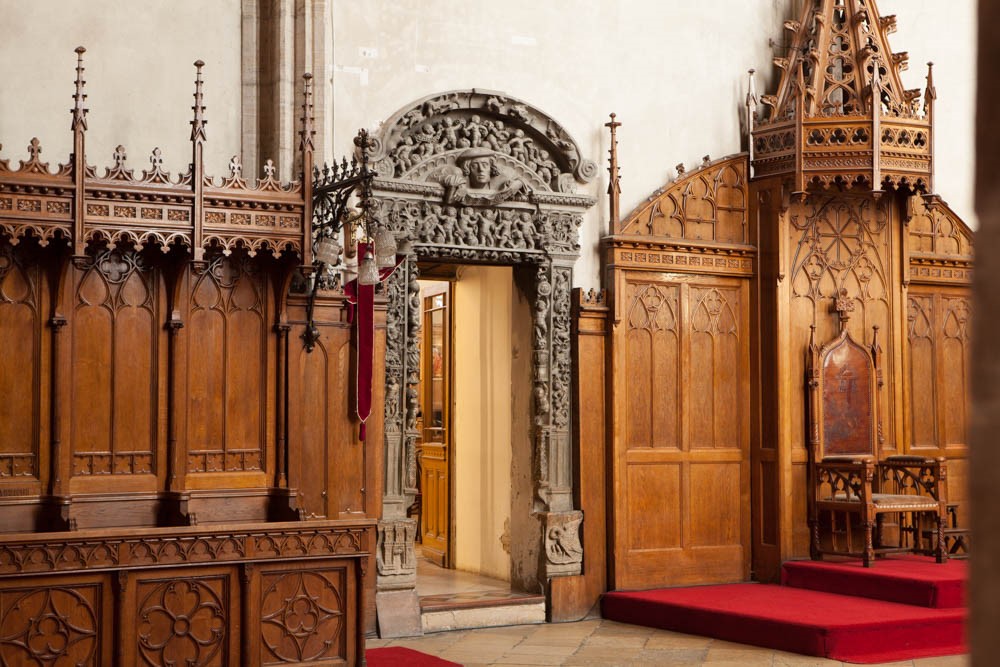
The “Saint Michael” Church is an impressive historical and religious monument, located in the central area of Cluj, in Union Square. This is an important Gothic style building made in Transylvania, being the second largest Gothic church in Romania. Most of the church is built in Gothic style, but over time the interior has undergone several restorations in the Baroque style. One of the most important ornaments of the church, the door frame of the sacristy, dates from 1528 and is made in the late Renaissance style. Also, the church tower is built in neo-Gothic style, with a height of 80 meters, being the church with one of the tallest towers in Romania.
Historians claim that in the basement of the church there is a crypt, made during the Middle Ages, which houses the tombs of personalities from that period, with important heritage objects. Numerous meetings of the Transylvanian Diet were held in this church and the princes Sigismund Báthory, Sigismund Rákóczi, Gabriel Báthory and Gabriel Bethlen were enthroned in this church.
The year 1918 marks the achievement of the Romanian unitary state through the political-administrative union of the Romanian territories under the jurisdiction of the Austro-Hungarian Empire and the Tsarist Empire with Romania Kingdom. Right after the Great Union, an Orthodox episcopal see with the title of Episcopacy of Vadu, Feleac and Cluj was re-established in Cluj.
As early as the following year, Bishop Nicolae Ivan proposed the construction of an Orthodox cathedral in the park in front of the Cluj-Napoca National Theater “Lucian Blaga”, in Avram Iancu Square. Thus, between 1923-1933, at the initiative of the bishop and with the support of the Royal House of Romania, the Episcopal Cathedral was built, one of the most important monumental buildings in Romanian style made after the Great Union of December 1, 1918. It is made in Byzantine style with defining elements of the Brancoveanu style, according to the project of the architects George Cristinel and Constantin Pomponiu.
The consecration of the cathedral took place in a festive setting in 1933, the service being officiated by the Patriarch of Romania (Miron Cristea), the Metropolitan of Transylvania (Nicolae Bălan) and the Bishop of Cluj (Nicolae Ivan). The festivity was attended by King Carol II and Crown Prince Michael, as well as members of the Romanian government.
Between 1997 and 2000, at the initiative of Archbishop Bartholomeu Anania, began an extensive process of renovation of the cathedral, a process in which it was possible to add elements from the initial project that in the ’30s could not be completed. The 4 towers that frame the central tower were added, the sculpture of the 18 huge columns from the roundabout of the big tower was made, the eight medallions carved in stone and the stone arches on the side facades were made. In 2001, His Eminence Father Bartholomeu, together with the Diocesan Council, decided to endow the cathedral with a monumental iconography in mosaic technique.
In the cathedral there is an icon of the Virgin Mary with the Baby painted in 1673 by the priest Luca de Iclod, an icon that is part, along with the icon from Nicula Monastery and the icon from the Piarists Church in Cluj, from the category of famous Transylvanian icons painted by the same priest. In the basement of the cathedral there is a museum that presents the history of the Orthodox dioceses in the Cluj area, the iconographic art starting with the 14th century and the crypt of the hierarchs.
Bánffy Castle from Bonţida is one of the architectural monuments representative of the Transylvanian Baroque style, the richness of elements specific to this architectural style also bringing it the name of “Transylvania’s Versailles”. According to historical documents, the castle took the place of a former mansion, a noble residence that existed around the 14th century.
King Sigismund of Luxembourg donated to the Bánffy family, in 1387, the estate on which Bánffy Castle now stands. Dionisie Banffy starts the construction of the castle in Bonţida commune, a place located approximately 30 km north-east of Cluj-Napoca. The construction was designed to have the shape of the letter “L”, in the first phase being built a fortress surrounded by a fortifications system, with strong stone walls and doors carved in Renaissance style.
The tower located at the entrance to the castle, had an important defense role. Symmetrical alleys, long terraces, airy atmosphere, are the things that completed the castle park, making it look unique.
The main buildings of the palace are dominated by architectural elements specific to the Renaissance style, in the 18th century being made extensions in the Baroque style.
The reconstruction of the castle, in Austrian Baroque style, is initiated by Dionisie Bánffy II, starting with 1745, according to the plans of the Viennese architect Joseph Emanuel Fischer von Erlachc. He gives a new shape to the palace, like the letter U, by creating new buildings: the riding hall, the stable, the shed and the servants’ houses. The amusement park keeps the same baroque style, being provided with symmetrical alleys, the lake on the right side of the castle from where you can admire the romantic side of the castle, statues, obelisks and artesian wells.
The next descendant of the family, József Bánffy, changes the appearance of the estate by demolishing the gate tower and redefining the sober baroque forms in the park, with more free, romantic forms, characteristic to English ones. Also during the reign of József, a new wing of the building was raised, and a water mill was built from the material resulting from the demolition of the tower, made available to the villagers.
In 1944 the castle was used as a military hospital, and at the end of World War II it was largely damaged by vandalism and arson by retreating German troops. After 1950, one of the wings of the castle became the headquarters of the Bonţida Agricultural Production Cooperative.
The domain of the Bánffy family was not limited only to the Bonțida Castle, but also extended within the Răscruci village, located in the same commune. Bánffy Castle from Răscruci was built in the 18th century, in an eclectic neoclassical style, the residence being surrounded by one of the most beautiful parks of the Bánffy family estates. The palace belonged to the Bonţida estate and was used as a summer residence by the Bánffy family, the two residences being connected by a poplar alley.
Currently, Bánffy Castle from Bonțida is under the administration of the Transylvania Trust Foundation, which aims to restore and capitalize on the potential of the Bonțida estate. Numerous cultural-artistic activities are currently organized here, activities that attract many visitors.
The castle became famous due to the fact that every year it hosts the famous Electric Castle music festival. The festival initiated on the castle estate in 2013, taking place over 3 days, in which lovers of different musical genres lived a unique experience in Romania. From one year to another, the festival becomes more and more popular, registering increases among the participants, the scenes used, innovation and creativity. The 2019 edition marked the existence of the first festival in Romania that translated for those with hearing impairments, the most important concerts, using sign language.
Among the most important awards obtained by the festival are the Best Camping Award at the European Festival Awards in 2017, the Best Food & Drinks Award at the European Festival Awards in 2018 and the Best Medium Sized Festival award at the European Festival Awards in 2019.
The access to the castle is made from the national road leading to Bonțida, a commune located about 30 km from Cluj-Napoca.
The castle awaits its visitors with its gates opened every day.
Just 33 km from Cluj-Napoca, in Luna de Jos, Dăbâca commune, we can admire an old tower that once belonged to a beautiful castle built in Renaissance style, Teleki Castle. Its construction was started by the Transylvanian noble family Teleki, in the second part of the 17th century, being completed in 1700 by Pál Teleki (1677-1731).
The political orientation of the family attracts the retaliation of the imperial army that destroys the building, today only the old hunting tower with a height of about 35 m and part of the domain park can be admired. Thus, the material resulting from the demolition of the castle was used to build a wall of about 700 m long and one meter thick, which was intended to protect the new pavilion built in neoclassical style, arranged on two levels: ground floor and first floor.
Due to the over 500-year-old specimens of existing trees (oaks, beeches, chestnuts), the park around the tower is still an attraction for tourists.
Currently, the pavilion has a care and assistance center for helping the elderly with disabilities, protected by approximately 200 m kept from the old wall.
On a terrace on the bank of Someş river near Dej, in Mănăstirea village, Mica commune, in the 16th century, Kristof Kereszturi built an important castle: Kornis Castle. Due to the stone statues in the form of unicorns, guarding the entrance to the castle, the castle is also known as the castle with unicorns.
Following the marriage between Korniș Boldizsár and Kristof Kereszturi’s daughter, the castle belongs to the young couple. The development of the castle is closely related to the Korniş family name, whence the name of the castle. During that period, the extension of the second floor was made, two bastions were added on the north side, the rooms of the castle were decorated as well as the access tower to the castle was rebuilt. The tower was protected by a water ditch, which is still preserved today. An icon sculpted in 1700, gave people faith that the Mother of God is the protector of the castle, this icon still exists today at the Dej Municipal Museum.
The last changes to the castle were made during the time of Kornis Zsigmond. During that period, two new octagonal bastions were added in the northern part of the castle, the tower at the entrance was rebuilt, and the rooms of the castle were redecorated with frescoes on the ceilings.
In case of danger and during the night, the suspension bridge at the entrance was lifted, therefore providing additional security to the castle.
After nationalization, impressive book collections (a library of about 9,000 volumes) as well as a real hunting museum were destroyed. The castle is private property, but it can be visited because it’s fenceless.
In the Middle Ages, the Gilău domain was owned by the Bishopric of Transylvania, and the town – formed near the Roman fortress – was one of the bishop’s residences. The medieval fortress of Gilău is mentioned in documents from the year 1428, during the time of bishop Gheorghe Lépes. From the time of Bishop Ladislau Geréb (1479-1502), the cousin of King Matthias Corvinus (1458-1490), have been preserved the first elements of artistic value of the episcopal residence in Gilău. Among these we mention:
– Bishop Ladislau Geréb’s coat of arms (leaning lion in a crown, currently located in Cluj-Napoca, National History Museum of Transylvania)
– Two identical rectangular pieces decorated with fasces laureati (a symbol of victory in the Roman era, also used in Renaissance art), carved in stone, built into the fireplace of the upstairs salon.
– A rectangular piece decorated with the figure of the Archangel Michael slaying the dragon (currently located in Cluj-Napoca, National History Museum of Transylvania).
In 1541, in the Gilău castle was signed the agreement regarding the unification under the leadership of the Habsburgs of the Hungary Kingdom territories not occupied by the Ottomans. From 1580 the domain had several owners: in 1587 the governor John Ghiczy, in 1597 the bishop of Transylvania Dimitrie Náprágyi, between the years 1600-1603 the owners were Mihai Viteazul, Ștefan Csáky and general Giorgio Basta, in the years 1603-1605 the noble Pancrațiu Sennyei. After sieging the castle in 1605, Prince Ștefan Bocskai also ordered the first inventory of it.
During the reign of Prince Gheorghe Rákóczi I, the castle became a princely residence and was radically modified. In 1663 the Gilău castle and domain was mortgaged to the noble Dionisie Bánffy, Comite of Dăbâca. Between 1704-1705, during the Revolt of the Hungarian Aristocracy, it was damaged.
In 1874 the castle was bought by Bernat Rosenberger. He is responsible for the renovation and reconstruction of the castle after the fire from 1861. In 1911 it was bought by Countess Ecaterina Bánffy. She owned it until its nationalization in 1948. After 1972, the castle was used as a school for disabled children until 2002, when it was returned to the old owner. The current owner renovated the castle through a project with European funding. In the near future, it is planned to rehabilitate the entire domain adjacent to the castle.